
Submission to the Department of Health and Social Care

The solution the consultation asked for now exists.

From April 2027, vending machines in England may not sell high-caffeine energy drinks. The consultation outcome rejected age-verification technology, and said in the same section that the government would work with industry should solutions develop. One has. This page sets out what we have asked the Department for, and how your organisation can ask for the same thing in its own name.

April 2027

When the vending machine provisions take effect. The regulations are being drafted now, which is why the next few months matter.

Consultation outcome, 16 July 2026.

2,850

Smart fridges in the UK, the sector's fastest growing format, up roughly 50 per cent in a single year.

Automatic Vending Association census, reported May 2026.

£43m

The industry's own estimate of lawful adult sales lost each year to a complete vending ban.

Industry estimate cited in the consultation outcome, July 2026.

Why this matters to your business

Smart vending is the only part of unattended retail that can meet this condition.

The consultation outcome gave four reasons for rejecting age verification at vending machines. They were that the technology is not used consistently, that its reliability is unproven, that its effectiveness depends on the setting, and that the hardware is expensive to install. Every one of those describes an age-check unit bolted onto a mechanical dispenser. None of them describes a smart cooler, where the lock, the connection and the software are already in place. They are what makes it a smart cooler.

That leaves this sector in an unusual position. Smart coolers and AI vending are the only forms of unattended retail with the software already present to confirm a buyer's age before the goods can be reached. A micro market cannot meet that condition, because the shelves are open and the check comes after the goods are in hand. A traditional machine cannot meet it, because it has no way of knowing who is standing in front of it and no means of finding out.

If the exclusion is granted, smart vending would be the only form of unattended retail in England permitted to sell these drinks at all. That is a durable commercial advantage, and it is worth putting in front of a site owner deciding what equipment to install. It is also the difference between the ban ending this category and the ban ending it only on machines that cannot check age.

We have made our own submission to the Department. We would urge you to make one too, in your own name and from your own interest. Our submission is below for background rather than for copying. Alongside it is a short statement drafted for organisations that would rather not write from scratch, which can be signed and sent as it stands.

Nubar Technology Ltd, August 2026

The distinction

Two machines, one word.

The consultation, its outcome, and the reporting around both use the phrase "vending machine" for two categories of equipment with almost nothing in common beyond refrigeration.

A traditional vending machine

A mechanical dispenser. Money in, coil turns, can drops.

  • Cannot know who is standing in front of it, and has no means of finding out
  • Age checking means new hardware, installed and configured machine by machine
  • No record of who bought what, so enforcement depends on test purchasing
  • Remains banned from selling these drinks under this proposal, exactly as announced

A smart cooler

A locked, internet-connected fridge. The door opens only when software says so.

  • Decides who may open the door before the customer can touch a product
  • Needs no new hardware. The check runs once, on the customer's own phone
  • Every opening traceable to a verified account, every check to a certified provider
  • An officer can test it in sixty seconds, with no child participant and no RIPA authorisation
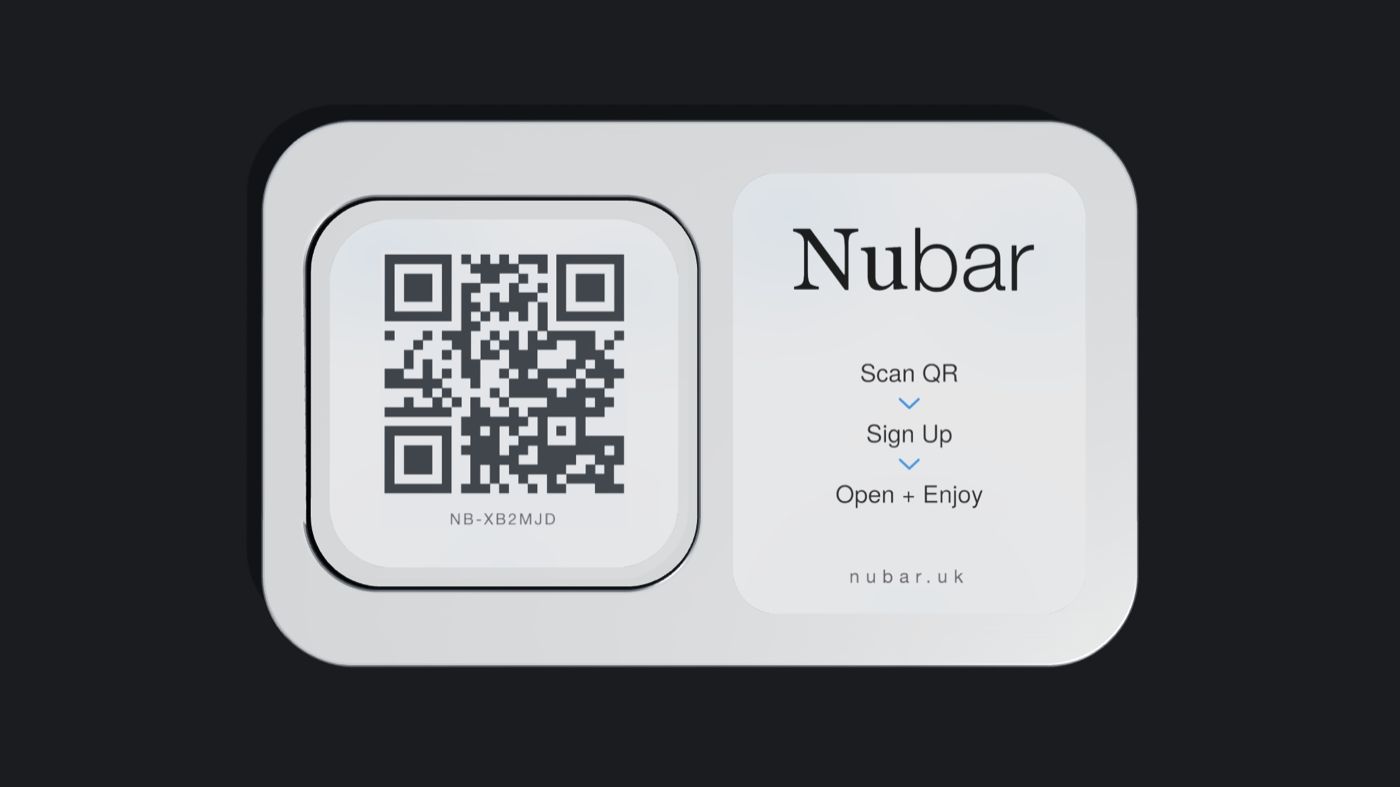
A brushed metal Nubar plate carrying a QR code, a machine reference, and the words scan, sign up, open and enjoy.

On the cost objection

This is the hardware.

The consultation outcome objected that age-verification hardware has a high cost to install and use, and may not be profitable for many vending businesses. We agree, for hardware, on traditional machines.

A smart cooler requires none. The plate above is the entire machine-side installation: a printed code, fixed to the door. The age check itself runs once per customer, on the customer's own phone, and costs pence rather than hundreds of pounds. It is a network cost rather than a per-machine one.

The Department's cost objection was an objection to retrofitting the wrong machines.

What it looks like

The check sits in front of a locked door.

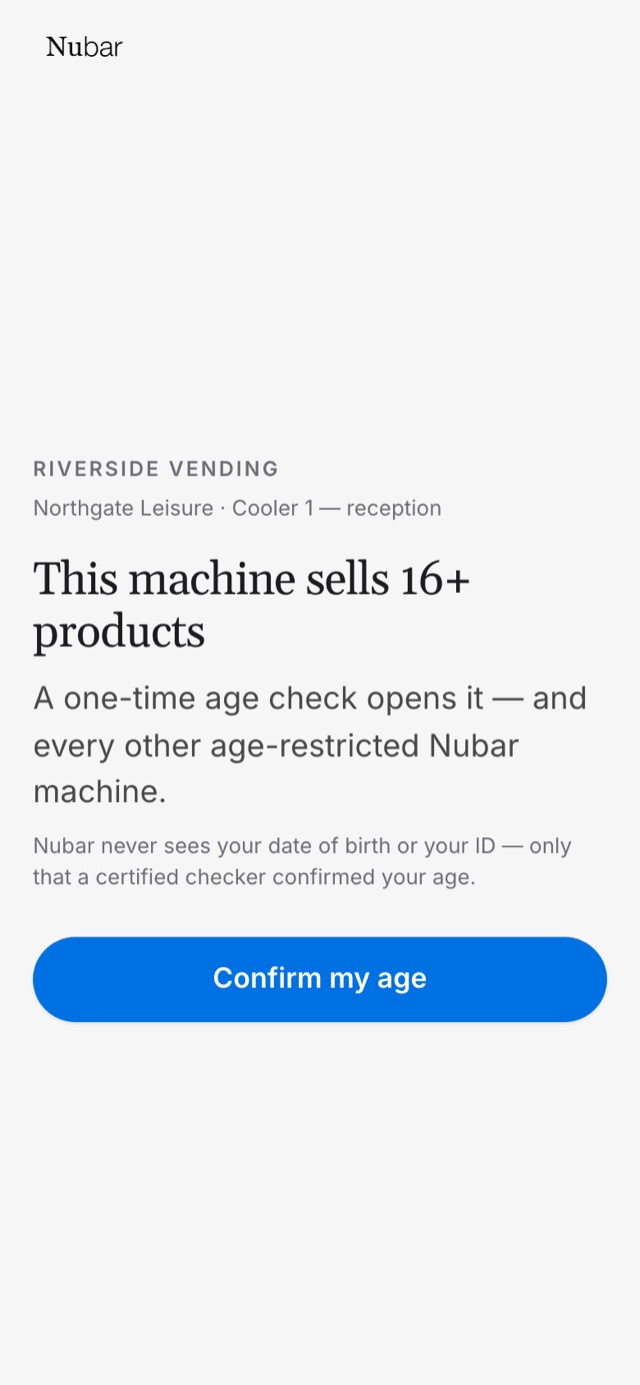
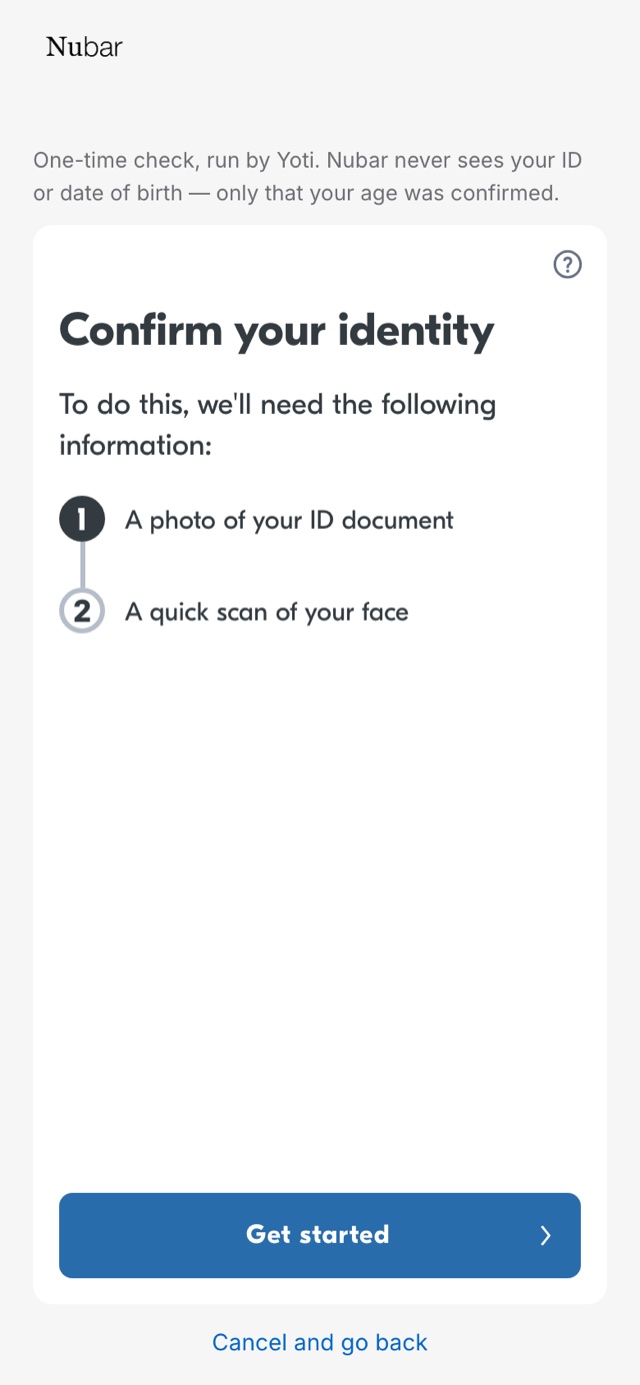
These are the screens as they run today. An account that has never completed a check cannot open a machine that stocks these drinks. It is not a notice to dismiss or a box to tick. The door does not release.

A phone showing the message this machine sells 16 plus products, with a one-time age check needed to open it, and a note that Nubar never sees a date of birth or ID.

Refused, before the goods can be reached

Every machine on the network requires 16 or over unless the operator attests it stocks nothing age-restricted, and that attestation is logged with its wording and the time.

A phone showing the age check run by Yoti, asking for a photo of an ID document and a quick scan of the face.

One check, by a certified provider

An identity document and a liveness check, about a minute, once. Nubar stores the confirmed attribute and the provider's reference. Never the document, the image, or the date of birth.

Screens from the application as it runs today. The age check runs against the provider's sandbox until a commercial agreement is in place, which returns approved sample results rather than assessing a real document.

The ask

One narrow addition, in three possible forms.

Nothing here reopens the age threshold, the caffeine definition, or the decision that traditional vending machines cannot sell these drinks. All of that should stand.

First preference

A conditional exclusion

Written into the regulations as drafted, on the conditions set out below. A machine that cannot meet them, which includes every traditional vending machine in the country, remains banned.

The smallest step

A power to designate by notice

A short provision letting the Secretary of State recognise approved verification standards later, against published criteria. On the day the regulations come into force it changes nothing. It means recognising a proven system is an administrative act rather than fresh legislation.

At minimum

A commitment to review

A named commitment that certified age-verified sale from smart coolers will be assessed at the post-implementation review, informed by a supervised pilot run before the ban takes effect.

The conditions

What a qualifying machine would have to do

A sale would fall outside the vending machine prohibition only where all of the following are met. The burden of showing they were met at the time of any sale rests on the seller.

  1. Locked by default. The goods are physically inaccessible until released by the machine.
  2. Released only to an account. Release requires authentication of an identified customer account, not merely payment.
  3. Verified before access. The account holder has been verified as 16 or over by an age-assurance service certified under the UK digital verification services trust framework.
  4. Logged. A record of each release and sale, including the verification reference, is retained and produced to an authorised officer on request.
  5. On unless attested off. Where such a machine stocks these drinks, the verification requirement cannot be disabled, and any general capability to disable it must itself be recorded.

A machine relying on payment alone would not qualify.

On the obvious objection

This is not the ban acquiring a loophole.

We would not ask any minister to carry the story of a ban acquiring its first exception, and we think the accurate description runs the other way.

Nothing about the ban weakens. Every machine that cannot prove its buyer's age stays banned, which is every machine the consultation considered. What changes is that England would become the first country in which an energy drink can be sold by a machine only after that machine has proved, through a government-certified check, that the buyer is at least 16. That is a stricter test than any staffed counter in the country is held to.

The ban is not being relaxed. It is being enforced by lock and record in the one place enforcement by signage was never going to work.

Our interest, stated plainly

If the regulations recognise certified age verification at smart coolers, Nubar's product becomes more valuable. So does the product of any competitor meeting the same certified standard. This asks for a standard, not for Nubar. We are not seeking an exclusive position, approved-supplier status, or any arrangement that names a company rather than a capability. Nubar does not manufacture machines, does not own them, does not stock them, and earns nothing from any individual sale decision.

The document

The Exemption Coalition Statement

A short statement that any organisation in the sector can sign in its own name. It does not endorse Nubar, does not name a supplier, and asks for no preferential treatment for anybody.

Statement on the vending machine provisions of the forthcoming regulations on high-caffeine energy drinks

Accompanying the submission entitled A future-proof ban. Nubar Technology Ltd, August 2026.

To the Department of Health and Social Care,

The organisations signing this statement build, operate or supply the software behind smart coolers. We welcome the government's decision to end the sale of high-caffeine energy drinks to children, and we take no issue with the age limit chosen, the definition adopted, or the conclusion that a conventional vending machine has no reliable way of judging a buyer's age.

Our request to the Department is a limited one. Where a machine is incapable of handing over its contents to anyone whose age has not been confirmed by an assurance provider certified under the government's digital verification framework, and where a full record of each transaction is kept for enforcement purposes, we believe the sale should sit outside the prohibition applying to vending machines. Equipment without that capability would remain within the ban as announced.

In practice, a qualifying machine would keep its stock behind a locked door, release goods only to an identified account whose holder had already passed a certified age check, hold a record of every opening and every check for production to an authorised officer on demand, and be incapable of selling restricted drinks with the check switched off. It would fall to the seller to show that these safeguards were in place at the time of any sale. A machine relying on payment alone would not qualify.

We recognise that the Department may wish to see further evidence before writing such an exclusion into the regulations. A workable alternative would be a provision enabling the Secretary of State to recognise approved verification standards by notice, against published criteria, once the evidence is judged sufficient. At minimum, we would ask that the question be examined at the post-implementation review, informed by a supervised pilot conducted before the ban takes effect in April 2027.

No signatory seeks preferential treatment. Our shared position is that any provider certified to a published standard should be able to serve any machine, whoever manufactures it. We are prepared to make our equipment available for a supervised pilot with the Department and Trading Standards, to accept unannounced test access by enforcement officers, and to have the findings published in full.

The signatories consent to this statement being shown to the Department of Health and Social Care and to Members of Parliament.

Signed for and on behalf of the organisation named below.

Organisation
Name
Position
Signature
Date

Add your organisation

Send the statement to the Department

The button below downloads the statement and opens an email to the Department's public enquiries address, with a covering note already written. Sign the statement, attach it, and send. It takes about two minutes.

Just download the statement

Addressed to dhsc.publicenquiries@dhsc.gov.uk. The email opens in your own application, from your own address, and nothing is sent until you send it. Read the covering note and change anything you do not agree with.

Submissions can also go through your own Member of Parliament, who can forward them to the Minister for Public Health and to the officials preparing the regulations. That is the route our own submission took, and it is worth the extra day it costs.

The offer

A supervised pilot, at no cost to public funds.

We have offered the Department and National Trading Standards a defined estate of smart coolers running certified pre-access age verification, beginning before commencement in April 2027, with the full audit trail made available, unannounced test access on demand, and the results published whatever they show.

We would work with officials to agree the test protocol in advance, and we would want that protocol published as an open standard that any certified provider can be assessed against.

We would also welcome the chance to demonstrate the system. It takes about five minutes, which is roughly four longer than the age check itself.